
Yarn Weight Chart: Categories 0–7, Labels and Gauge
Find CYC yarn categories from lace to jumbo, understand what the label numbers mean and use a swatch before choosing a substitute.
In this guide
Yarn weight means a thickness category
In a yarn weight chart, “weight” describes a broad thickness category, not how many grams a ball weighs. The Craft Yarn Council (CYC) numbers its categories from 0 to 7. A 100 g ball can belong to any of those categories; the category number is not its mass, number of plies or required needle size.
Use this reference to identify a category and interpret a label. It summarizes common names and knitting gauge in stockinette over 4 inches. It is not a universal substitution chart or a crochet gauge table. The linked CYC source includes crochet ranges and fuller tool guidance.
Yarn weight chart: categories 0–7
| Category | Common names | Stitches over 4 in |
|---|---|---|
| 0 · Lace | Lace / fine yarns | 33–40* |
| 1 · Super Fine | Sock, fingering, baby | 27–32 |
| 2 · Fine | Sport, baby | 23–26 |
| 3 · Light | DK, light worsted | 21–24 |
| 4 · Medium | Worsted, afghan, Aran | 16–20 |
| 5 · Bulky | Chunky, craft, rug | 12–15 |
| 6 · Super Bulky | Super bulky, roving | 7–11 |
| 7 · Jumbo | Jumbo, roving | 6 or fewer |
*Open lace often uses a different gauge; follow its pattern. These are guidelines, not acceptance limits for every stitch structure. Category names and ranges: Craft Yarn Council. Our table and illustrations use original formatting, not the CYC graphic symbols.
Read the label without mixing up the numbers
Look for category, ball mass, length, fiber composition, suggested tools, gauge and care information separately. For a replacement yarn, also record its exact product/color and dye lot where supplied. A large “4” category label and “100 g” describe different things.
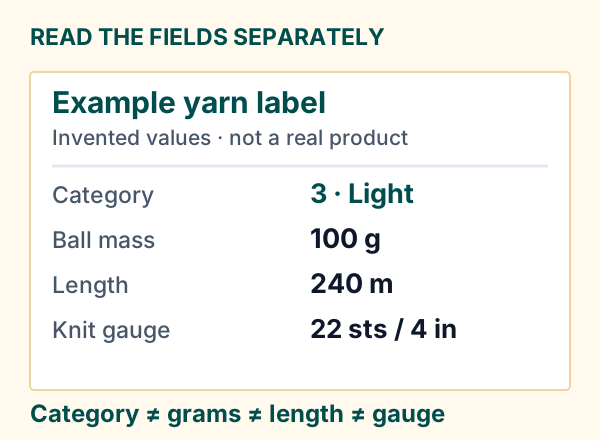
In the illustrated example, 3 Light identifies the category. 100 g tells you the ball mass and 240 m its length. 22 stitches over 4 inches is a knitting gauge example. It does not mean 22 stitches per inch, and it does not establish the gauge you personally will get. Read any actual label with its stated stitch pattern and measurement span.
Use the chart in a real project
Start with the pattern
Record the required yarn, stitch pattern, stitch and row gauge, recommended tool and finishing instructions. A broad category is only an initial filter; the actual fabric and intended fit still matter.
Compare the candidate yarn
Check category and label information, but also composition, structure, care and length per ball. Do not assume two category-4 yarns feel or behave alike. Check whether the pattern relies on stretch, a crisp texture or a soft drape.
Make and measure a representative swatch
Work the intended stitch with the candidate yarn and tool. Make enough fabric to measure away from distorted edges. Finish it as permitted for the planned project and measure without stretching. Keep the stitch count and span together in your notes.
Compare both gauge and fabric
Count across for stitch gauge and vertically for row gauge. If the dimensions match but the fabric is too stiff, open or heavy, reconsider the yarn. The goal is a suitable finished fabric, not just a matching category number.
Worked lookup: category is not a size guarantee
Suppose your pattern needs 22 stitches over 4 inches. Category 3 is a useful place to begin looking, but a candidate still needs a swatch. If your finished sample gives 20 stitches over that same span, 110 stitches would make 110 ÷ (20 ÷ 4) = 22 inches, rather than the intended 110 ÷ (22 ÷ 4) = 20 inches. This is an arithmetic illustration, not a measured yarn test.
Match the span exactly. Four inches equals 10.16 cm; a pattern written over 10 cm should be measured over 10 cm. Similar printed labels do not make those two dimensions mathematically identical.
Names that cause confusion
DK, light worsted and Aran
CYC groups DK and light worsted under category 3, and worsted/Aran under category 4. Product naming is not perfectly uniform across markets. Use the actual specifications and a swatch when comparing adjacent categories. Our DK versus worsted guide explains the size consequences.
Ply and grams
Do not read a regional ply-weight name as a guaranteed count of strands in the yarn. Likewise, buying the same number of 50 g balls does not establish the same total length. A useful shopping record includes both the ball mass and its actual meters or yards.
Knitting and crochet
The chart above is for stockinette knitting. It cannot be used as a single-crochet gauge range or a blanket yardage formula. Crochet stitch structure and pattern requirements need their own sample. See the hook size reference for tool markings, not a promise of one hook for every yarn in a category.
If the band or category is missing
Keep an unidentified yarn separate from a project that needs a dependable replacement. Compare what you can establish—fiber information, available length, care and sample behavior—but do not assign a guaranteed category from a photograph. A wrap measurement may help compare your own samples, but this chart does not supply universal wraps-per-inch or ply conversions.
Once you have a suitable sample, use the swatch-based yarn calculator to estimate quantity. Category alone cannot tell you how much yarn a blanket needs.
A useful estimate starts small.
Estimate project yarn from a measured and weighed swatch, with the assumptions kept in view.
Explore the planning toolSources & editorial notes
- Craft Yarn Council: Standard Yarn Weight System — https://www.craftyarncouncil.com/standards/yarn-weight-system
- Craft Yarn Council: Yarn Label Information — https://craftyarncouncil.com/standards/yarn-label-information
- Craft Yarn Council: Standards FAQs — https://www.craftyarncouncil.com/standards/faqs
- Lion Brand: Making a Gauge Swatch — https://www.lionbrand.com/pages/how-to-knit-making-a-gauge-swatch
- Editorial note: category/chart data checked 13 November 2026; label and numerical examples are invented teaching examples, not product tests. Original artwork; CYC graphic symbols are not reproduced.