
Aran vs. Worsted Yarn: Can You Substitute?
Aran and worsted names often overlap within CYC category 4 Medium, but two yarns with those names need not have identical thickness, gauge or length.
In this guide
Aran and worsted names often overlap within CYC category 4 Medium, but two yarns with those names need not have identical thickness, gauge or length.
| Question | What to use |
|---|---|
| Is it category 4? | Check the manufacturer label; CYC includes Aran and worsted among Medium names |
| Will it match a pattern? | Make the specified stitch and finish the sample |
| How many skeins? | Calculate required length and read the actual length per skein |
| Does worsted mean wool? | No; weight naming and fiber content are separate |
| Does worsted mean worsted-spun? | Not necessarily; spinning method and weight category are different concepts |
Why the terms overlap
Yarn names vary by market and manufacturer. Aran is often used for a fuller medium-weight yarn, but the word is not a precise universal diameter. A yarn sold as worsted by one maker can overlap another maker’s Aran. A category number narrows the starting comparison without replacing gauge or fabric judgment.
Compare the specifications
- Fiber percentages and any special treatment.
- Length and weight for the exact yarn and color.
- The manufacturer’s suggested gauge and tool size.
- Care instructions and the planned fabric structure.
- Pattern gauge, row gauge, repeats and finished dimensions.
Swatch the candidate in the actual stitch
Use the intended tool and make a sample large enough to measure a central area without including edge stitches. Wash and dry as the item will be cared for, then lay it flat without pulling it to the target. Count stitches and rows over the same measured span. Record the tool, dry dimensions and whether the fabric feels suitable. Cables, ribbing, lace and crochet textures need their own stitch-pattern samples; a stockinette label gauge cannot certify them.
A substitution example
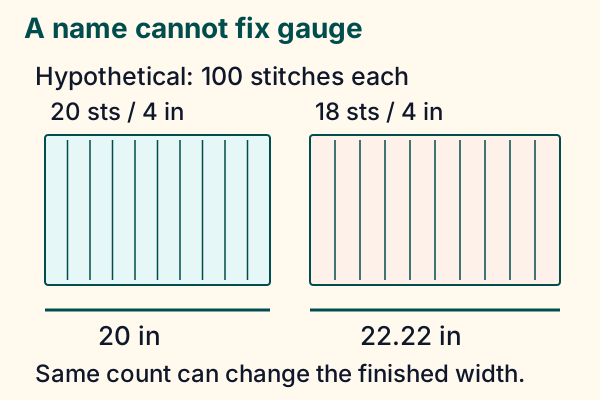
Suppose the original panel has 100 stitches at 20 stitches per 4 inches: 20 inches wide. A candidate sample gives 18 stitches over the same span. At 100 stitches it would be about 22.22 inches wide. To retain a simple 20-inch rectangle at that gauge needs 90 stitches before edge/repeat constraints. This arithmetic does not regrade a sweater’s armholes, neck or shaping.
Judge the fabric as well as the count
A needle change may bring the stitch gauge closer while creating a fabric that is too open or too stiff. Compare the dried sample’s drape, stretch and recovery. If the result differs from the design, choose a closer yarn or a pattern intended for the new fabric instead of forcing the name to match.
When a needle change is not enough
For a plain scarf, changing the stitch count may be a reasonable custom-size decision. In a sweater, a different row gauge changes the distance between increases, armhole depth and sleeve length even when stitch gauge matches. A wider gauge can also upset a colorwork or cable repeat. If you cannot reproduce the pattern fabric and both relevant gauges, choose another pattern or work through a complete redesign rather than simply casting on a smaller size.
Buy the right quantity
Do not replace five skeins with five differently sized skeins. Compare total length and round up to complete replacement skeins. For a custom blanket or panel, measure swatch consumption. Texture, borders, holding strands together and separate colors need their own consideration.
A sensible answer to “are they interchangeable?”
Sometimes, after a successful sample and dimensional check. The labels alone are not enough. Save the label and swatch notes so a later purchase or repair can reproduce the decision.
Related: DK vs. worsted and the swatch-based yarn calculator.
A useful estimate starts small.
Estimate project yarn from a measured and weighed swatch, with the assumptions kept in view.
Explore the planning toolSources & editorial notes
- Craft Yarn Council — Standard Yarn Weight System — https://www.craftyarncouncil.com/standards/yarn-weight-system
- Lion Brand — Choosing the Right Yarn — https://www.lionbrand.com/community/blog/choosing-the-right-yarn/
- Lion Brand — Yardage per skein — https://support.lionbrand.com/support/solutions/articles/17000035214-yardage-per-skein
- Lion Brand — Making a Gauge Swatch — https://www.lionbrand.com/pages/how-to-knit-making-a-gauge-swatch
- Sources checked 13 November 2026. Original arithmetic and schematic teaching diagrams; hypothetical samples are identified. No independent hands-on craft testing, product performance testing or named expert review is claimed.