
DK vs. Worsted Yarn: Differences and a Substitution Check
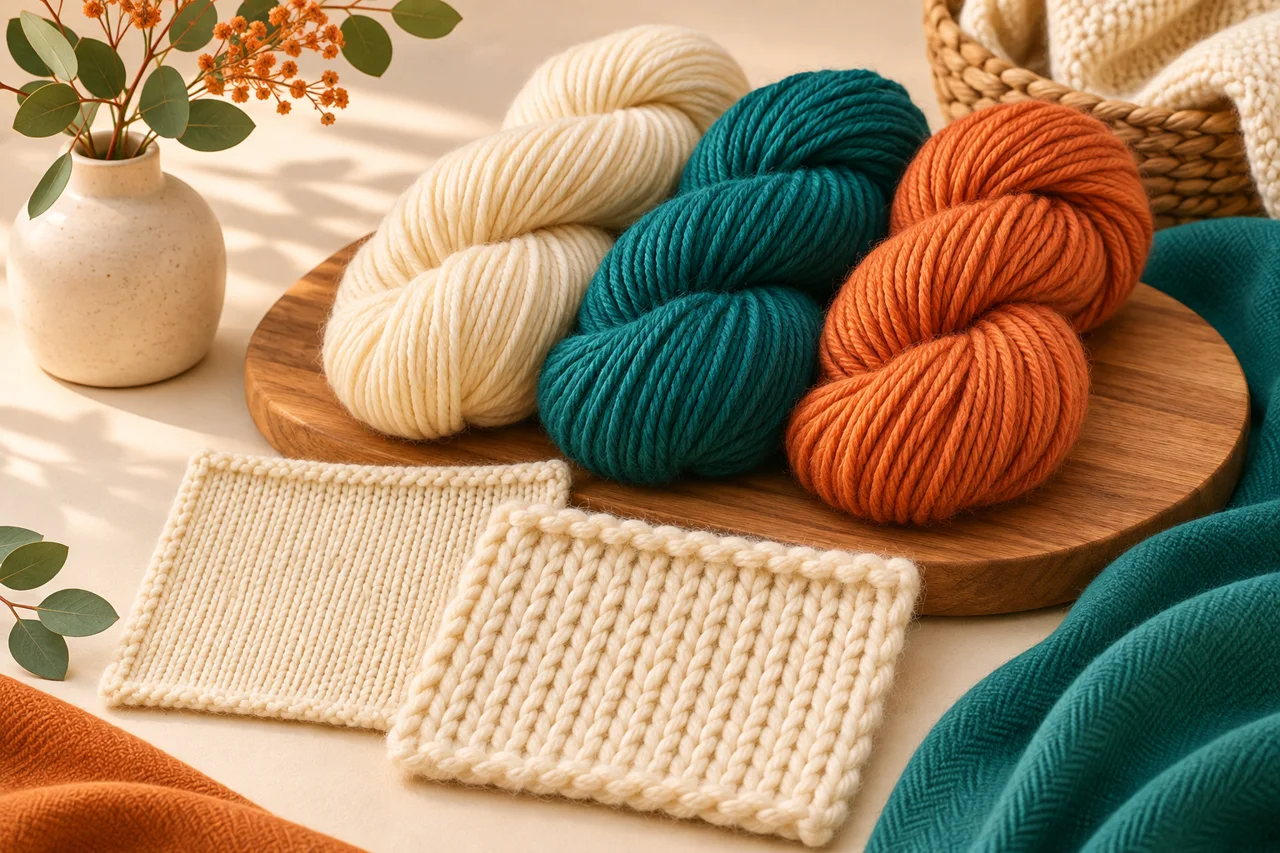
Compare DK and worsted by gauge, fabric and length—not just the weight name. See how the same stitch count can change width before substituting.
In this guide
The useful difference: start with gauge
DK usually falls in CYC category 3 Light; worsted falls in category 4 Medium. DK is generally the finer starting point, but neither name guarantees a particular finished fabric. The practical question is whether the candidate yarn can make the fabric and dimensions your project requires.
If you already have a pattern, start with its yarn and gauge. If you are choosing a new project, choose a pattern written for the yarn you want to use. That is usually simpler than converting a shaped garment between categories.
DK versus worsted at a glance
| Check | DK | Worsted |
|---|---|---|
| CYC group | 3 · Light | 4 · Medium |
| Stockinette stitches / 4 in | 21–24 | 16–20 |
| Common name overlap | Light worsted | Afghan / Aran |
| Useful first comparison | Pattern and label gauge | Pattern and label gauge |
| Quantity decision | Compare actual length | Compare actual length |
The ranges summarize the CYC system. They are not an instruction to force every yarn into the middle of its category. Fiber, construction, stitch structure and your tension also affect the result.
What a gauge change does to the same stitch count
Imagine two finished samples: one has 22 stitches over exactly 4 inches and the other 18. Keep a panel at 90 stitches and the arithmetic gives these widths:

- At 22 stitches per 4 inches: 90 ÷ (22 ÷ 4) = 16.36 inches, rounded.
- At 18 stitches per 4 inches: 90 ÷ (18 ÷ 4) = 20 inches.
That is why keeping the pattern’s stitch count can change size. The exact difference comes from these two chosen gauges. It is not a standard percentage for all DK and worsted yarns, and row gauge can change length independently.
Can you substitute worsted for DK?
Sometimes, but start by testing the intended stitch at the pattern gauge. If the thicker candidate only reaches that gauge as a rigid, unpleasant fabric, matching the number has not made it a suitable substitute. If you keep its looser gauge instead, the pattern needs more than a simple yarn-name swap.
For a plain rectangular scarf or blanket, recalculating width can be manageable. A fitted sweater also has armholes, neck shaping, ease, row counts and possibly stitch repeats. Choosing a different pattern is often a better first project than redesigning all of those relationships.
Can you substitute DK for worsted?
The same test applies in reverse. Larger tools may open up the finer yarn enough to approach a lower stitch count, but the fabric may become too open for the design. Do not assume a fixed needle-size change will solve it. Make a fresh sample, finish it appropriately and inspect the fabric before committing to the project.
Do not select a different garment size solely because its cast-on count looks convenient. Width and vertical shaping may no longer agree. A designer’s substitution advice or a pattern written for your yarn is a more dependable starting point.
A substitution check you can repeat
Write down the target
Record pattern stitch/row gauge and span, finished dimensions, intended ease, stitch repeats and any edge stitches. Note whether the pattern measures gauge flat or in the round.
Make the actual fabric
Use the candidate yarn, intended stitch and a sensible starting tool. Record the tool and finish the sample as your project will be finished. Check the care label before washing or heating.
Check dimensions and feel
Measure without pulling. Compare stitch and row gauge, drape, opacity and recovery for this particular project. Change one variable at a time and label each sample so the result is repeatable.
Recalculate only the parts you understand
For a simple rectangle, working stitches = desired width × measured stitches ÷ measured span. Add pattern repeats, borders and edge requirements deliberately. If the shaped construction is unclear, keep the original yarn or choose another pattern.
For example, a 20-inch plain panel at 22 stitches over 4 inches needs 20 × 22 ÷ 4 = 110 working stitches. A multiple-of-eight stitch pattern would need an intentional repeat/edge adjustment; blindly rounding the number can change the finished size.
Buy length, not an equal number of balls
Ball mass and usable length are different measurements. In a hypothetical shopping example, a pattern needs 900 m and the candidate contains 220 m per ball: 900 ÷ 220 = 4.09, so five whole balls cover that stated length. This calculation does not prove that a DK-to-worsted substitution will use the same 900 m. First establish a suitable fabric and estimate consumption for it.

Do not use a universal “DK needs this much more yarn” multiplier. Compare actual lengths, calculate each color separately and check whether the pattern already includes a reserve. The yarn yardage calculator scales measured sample consumption; it does not infer usage from the category name.
Which should you choose?
- Following a pattern: choose the specified yarn or a candidate that passes its gauge and fabric checks.
- Using yarn you already own: look for a pattern designed for its gauge before adapting a more complex one.
- Designing a simple rectangle: compare finished samples, choose the fabric you prefer and calculate the working count from that sample.
Holding two strands together is another fabric to test, not a guaranteed shortcut to a named weight. For the broader category system, keep the yarn weight chart alongside your pattern. For counts, use the knitting gauge calculator and review its repeat/edge assumptions.
A useful estimate starts small.
Estimate project yarn from a measured and weighed swatch, with the assumptions kept in view.
Explore the planning toolSources & editorial notes
- Craft Yarn Council: Standard Yarn Weight System — https://www.craftyarncouncil.com/standards/yarn-weight-system
- Craft Yarn Council: Standards FAQs — https://www.craftyarncouncil.com/standards/faqs
- Lion Brand: Making a Gauge Swatch — https://www.lionbrand.com/pages/how-to-knit-making-a-gauge-swatch
- Editorial note: source checks and independent arithmetic completed 13 November 2026. Gauge/quantity illustrations are hypothetical; no measured comparison sample or product performance test is claimed.