
Sewing Machines for Beginners: A Specification-Based Buying Guide
Choose for the projects you plan to sew, controllable speed, a clear manual and accessible support.

In this guide
This guide checks manufacturer specifications, not stitch quality from a studio test. Specifications were checked on 13 November 2026. Model names, included feet, voltage, warranties and availability vary by market; confirm the listing and manual supplied with your exact machine.
| Feature | Brother CS7000X | SINGER Heavy Duty 4423 |
|---|---|---|
| Controls | Computerized, LCD, adjustable speed control | Mechanical stitch-selection dials |
| Stitch count | 70 built-in stitches | 23 built-in stitches |
| Buttonholes | Seven one-step styles | One-step buttonhole |
| Bobbin | Quick-set top drop-in | Top drop-in |
| Check before purchase | Presser-foot pressure is not adjustable in the listed specifications | Confirm speed control, local package and intended fabric limits |
How to use these examples
These US-market examples illustrate two control approaches, rather than a ranked list of the best machines. The comparison uses manufacturer specifications read on 13 November 2026; it does not include a hands-on speed, feeding, noise or durability test. The SINGER lists 23 built-in stitches and 97 stitch applications, which count different things. A larger applications number is not 97 separately selected stitches. Check the exact package and local electrical rating before ordering an imported model.
Start with three real projects
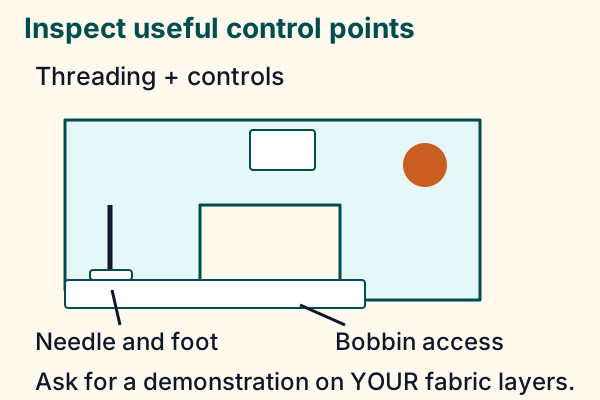
List what you want to make in the next few months: repairs, shirts, jersey garments, bags or patchwork. Ask a dealer to demonstrate your fabric layers with appropriate needles and thread. A fast advertised maximum speed is not a measurement of control at slow speed, motor torque or the ability to cross a bulky seam. Domestic “heavy duty” branding does not make a machine an industrial leather machine.
Compare useful features
- A readable threading diagram and a manual for the exact model.
- Slow-speed control that feels manageable, and a pedal you can regulate.
- A straight stitch and appropriate stretch/zigzag options for your projects.
- Buttonhole method, free-arm access, needle positioning and useful included feet.
- Correct bobbin/needle system, local service, parts, warranty terms and electrical compatibility.
Mechanical or computerized?
Mechanical machines usually use dials; computerized models may offer speed limiting and needle-position controls. Features vary: a mechanical machine can have a one-step buttonhole, and a computerized machine may lack adjustable presser-foot pressure. Neither category guarantees reliability or easy home lubrication. Follow the model manual for maintenance; do not oil a machine unless instructed.
| Task | What to observe |
|---|---|
| Thread and change a bobbin | Can you see and reach the guides, cover and lower thread path? |
| Start slowly on two layers | Can you make several controlled stitches and stop where intended? |
| Sew the intended bulky crossing | Does the sample feed without forcing or pulling? |
| Make a buttonhole on a sample | Can you position it, repeat it and understand the required foot/lever? |
| Unpick and restart a seam | Can you identify controls and recover without losing the manual route? |
Decide by the control you need
The CS7000X is worth investigating if adjustable speed limiting, electronic selection and the included table fit your planned learning. Check that its listed features, including the lack of adjustable presser-foot pressure in the specification, suit the fabrics you want to handle. The 4423 is worth investigating if you prefer mechanical dials and want a one-step buttonhole workflow; ask specifically to demonstrate slow pedal control on your sample. These are reasons to inspect the models, not verified ease-of-use or performance recommendations.
Before committing
Check the total cost of feet, bobbins and service, return conditions and whether instruction is available. If possible, test the machine on a sample seam, a corner and a buttonhole. The specification table is a shortlist aid; current prices and a product ranking are intentionally omitted because they require local market comparison.
Make room for the seam.
Calculate cut dimensions from finished dimensions and the seam allowances you choose.
Explore the planning toolSources & editorial notes
- Brother — CS7000X manufacturer specifications — https://www.brother-usa.com/p/sewing-embroidery/CS7000X
- SINGER — 4423 Meltwater Blue manufacturer specifications — https://www.singer.com/products/singer-heavy-duty-4423-meltwater-blue-sewing-machine
- Sources checked 13 November 2026. Original arithmetic and schematic teaching diagrams; hypothetical samples are identified. No independent hands-on craft testing, product performance testing or named expert review is claimed.
