Fabric Grainline and Bias: Warp, Weft and Cutting Layout
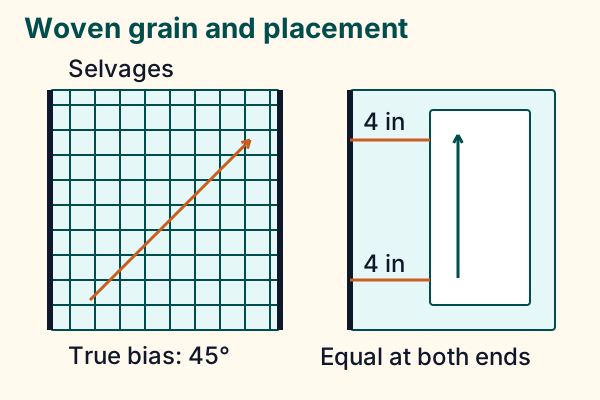
In ordinary woven fabric, lengthwise grain runs parallel to the selvages and crosswise grain runs across the width.
In this guide
In ordinary woven fabric, lengthwise grain runs parallel to the selvages and crosswise grain runs across the width.
| Direction | Relationship | What to check |
|---|---|---|
| Lengthwise / warp | Parallel to selvages | Pattern grainline and lengthwise stability |
| Crosswise / weft | Across the width, perpendicular to selvages | Crosswise placement when the pattern allows |
| Bias | Oblique to warp/weft | Potential movement and distortion |
| True bias | 45 degrees to warp/weft | Specified bias cuts, drape and stretch |
| Selvage | Manufactured lengthwise edge | Usually exclude from garment seam/body fabric |
Gather the layout tools
Use the complete pattern instructions, a ruler or tape, washable marking tool and pins or weights suited to the cloth. Prepare the fabric as its care and pattern require. Work on a flat surface large enough to support the piece; fabric hanging off the table can pull a correct grainline out of alignment.
Find and mark the grain
Identify both selvages before folding the fabric. A cut end from a shop is not always square to the grain. Smooth the cloth without stretching and check that the fold is not twisting. If the fabric is distorted, follow a suitable preparation method for that material rather than forcibly aligning a bad fold.
Place a pattern piece
Read the layout
Check fold, nap and directional-print instructions, as well as whether the piece is intended to be cut on lengthwise, crosswise or bias grain.
Measure the arrow
For a lengthwise grainline, measure from one end of the pattern arrow to a selvage or a confirmed parallel fold. Measure the other end to the same reference.
Make distances equal
Pivot the paper until both distances agree, without changing the specified fold/edge placement. Secure the pattern without distorting the cloth.
Check the whole piece
Confirm the complete outline fits within usable fabric, including the seam and hem allowances. Keep one-way prints and paired pieces consistent before cutting.
Verify before the first cut
Pin or weight one end of the paper grain arrow. Measure at a right angle to the same selvage, then pivot the other end until its distance matches. Recheck the first measurement after securing the second end. A pattern marked “place on fold” must actually meet a confirmed straight fold, not merely run near it. For one-way prints or nap, check every piece points in the instructed direction; equal grain distances alone do not ensure that. If the cloth refuses to lie flat, unfold it and investigate preparation or distortion rather than stretching it to fit the paper.
Why bias needs special handling
Woven cloth can move more along an oblique direction, with true bias commonly giving the greatest movement. The amount still depends on the material. Support bias-cut sections, avoid stretching during marking/sewing and follow the pattern’s hanging/hemming process. A bias cut is a design choice, not a free yardage-saving rotation.
Knits and stretch wovens
A knit has a different loop structure and may use a lengthwise wale direction and a specified greatest-stretch direction. A woven containing elastane can stretch along a straight grain too. The rule is not “wovens stretch only at exactly 45 degrees.” Measure the actual fabric behavior and use the pattern requirements.
Before using the calculator
The rectangular yardage tool keeps pieces in one chosen orientation and states its selvage/shrinkage assumptions. It cannot decide whether rotating an irregular garment piece preserves its drape or fit. Keep a scaled layout or full-size pattern placement for that decision.
Related: fabric width planning and binding strips.
Measure before the first cut.
Estimate yardage from your required dimensions, fabric width and chosen shrinkage allowance.
Explore the planning toolSources & editorial notes
- BERNINA — Woven grainline — https://www.bernina.com/bernina/media/BNZ/Projects/Grainline.pdf
- Sewing & Craft Alliance — Sewing with knits — https://www.sewing.org/files/guidelines/4_215_sewing_with_knits.pdf
- Sources checked 13 November 2026. Original arithmetic and schematic teaching diagrams; hypothetical samples are identified. No independent hands-on craft testing, product performance testing or named expert review is claimed.