
How Much Yarn Do I Need for a Blanket? A Swatch-Based Method
Use your pattern’s yardage first.
In this guide
Use your pattern’s yardage first.
Choose a reliable starting point
Blanket dimensions and yarn weight alone do not determine yarn use. A dense stitch, loose lace, a wide border and multiple held strands can produce very different totals. The manufacturer’s project ranges are a rough shopping guide, not an exact requirement for your blanket. If following a pattern, start with its stated size, yarn length and gauge.
Measure the yarn your fabric actually uses
Make a representative swatch
Use the intended yarn, needles or hook, stitch pattern and finishing. Measure the entire fabric sample whose yarn consumption you record; do not use only its center measurement while including an unmeasured border.
Record dimensions and yarn used
Wash and dry according to the yarn label. Measure width and length without stretching. Measure yarn length directly, or estimate length from dry swatch grams × label yards ÷ label grams. A very small swatch can magnify scale errors.
Scale and add separate elements
Required length = blanket area ÷ swatch area × swatch yarn used. Estimate a different border stitch separately. Add any reserve deliberately; 10% is an example choice, not a universal standard.
Convert length to skeins
Divide the total by the actual length per skein for that yarn and color, rounding upward. Calculate separate colors independently and check dye-lot availability. One skein is not a fixed length.
Worked example: replace these hypothetical numbers
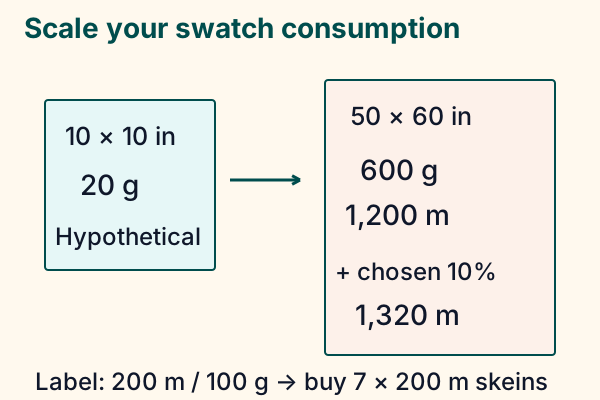
A finished 10 × 10 inch swatch has 100 square inches of area and hypothetically uses 20 g of yarn. A 50 × 60 inch interior has 3,000 square inches, so estimated mass is 3,000 ÷ 100 × 20 = 600 g. With a hypothetical label of 200 m per 100 g, each gram represents 2 m: 600 × 2 = 1,200 m. A deliberately chosen 10% reserve gives 1,320 m. Divide by 200 m per skein and round 6.6 upward to seven skeins, providing 1,400 m. This example estimates that same fabric only, before any separately calculated border. Do not multiply square inches by consumption measured per square centimeter.
Before buying
- Check whether the pattern already includes a reserve before adding another.
- Keep width/length in the same units; use label meters when working in meters.
- For stripes, count the area or rows in each color rather than dividing skeins equally.
- Save a label and your swatch record for repairs and later repeats.
Use the swatch-based yarn calculator and the blanket planning dimensions together.
Measure consumption you can reproduce
Weigh the dry sample on a scale precise enough for its mass, keeping the same tail convention for each sample. A large relative scale error on a tiny swatch becomes a large blanket error. If using grams, convert with the exact yarn label length ÷ label grams; this assumes the sample represents that yarn’s mass-to-length ratio. Alternatively, measure the length consumed without stretching it. Record sample dimensions after the planned care, the stitch, hook or needle, and whether edge stitches are included. A sample with unusually dense edging can overstate a large plain interior; a large sample or separate interior/border trials can reduce that mismatch.
Split colors and construction tasks
For stripes, calculate the area or rows assigned to each color using the same stitch and gauge, then round each color to complete skeins independently. Seven total skeins does not ensure that a particular contrast color will last. For motifs, make a complete finished motif with its tails and estimate motif count, then add measured joining and border consumption separately. A dense edging around the whole blanket cannot be inferred from a small interior square. If holding two strands together, each strand consumes approximately the worked path length; keep a separate purchase calculation for each yarn.
Use the estimate at purchase and during work
Check dye-lot requirements and the seller’s return conditions, then keep labels and remaining skeins together. A chosen reserve covers uncertainty but cannot guarantee the exact finish, especially if you change gauge, size or stitch after buying. As the blanket grows, compare the grams or length used against completed area, accounting for borders still to come. If consumption is substantially different from the sample, pause early and recompute rather than assuming the last skein will stretch farther.
A useful estimate starts small.
Estimate project yarn from a measured and weighed swatch, with the assumptions kept in view.
Explore the planning toolSources & editorial notes
- Lion Brand — Making a Gauge Swatch — https://www.lionbrand.com/pages/how-to-knit-making-a-gauge-swatch
- Lion Brand — Yardage per skein — https://support.lionbrand.com/support/solutions/articles/17000035214-yardage-per-skein
- Lion Brand — How Much Yarn Do You Need? — https://www.lionbrand.com/pages/how-much-yarn-do-i-need
- Sources checked 13 November 2026. Original arithmetic and schematic teaching diagrams; hypothetical samples are identified. No independent hands-on craft testing, product performance testing or named expert review is claimed.