
Wool vs. Acrylic Yarn: Care and Project Choice
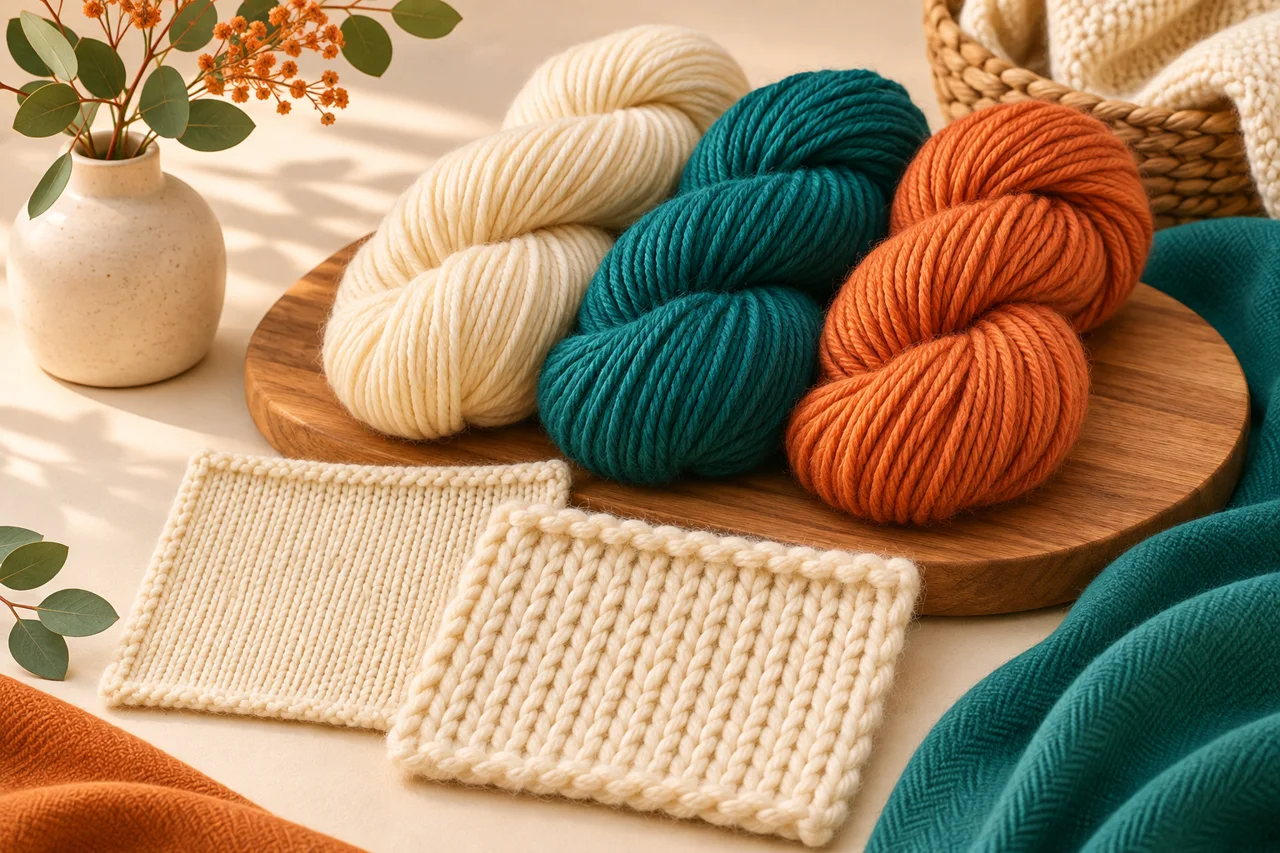
Wool is an animal fiber and acrylic is synthetic.
In this guide
Wool is an animal fiber and acrylic is synthetic.
| Question | Wool | Acrylic |
|---|---|---|
| Care | Depends on treatment/blend; read label | Often easy-care; still read label |
| Heat | Use only permitted conditions | Heat may permanently distort or damage |
| Fabric behavior | Varies with spinning, breed and treatment | Varies with construction and finish |
| Substitution | Test finished sample | Test finished sample |
Which one suits the project?
For a frequently washed gift, begin with care the recipient can actually follow, then compare suitable yarns within that constraint. For a textured garment, compare a finished sample’s drape and ability to hold the intended shape. For a budget limit, compare cost per usable length, not price per ball. Neither fiber is a universal winner: spinning, blend, finish and stitch structure can change what you feel and how the item behaves. A yarn that feels acceptable on a hand may still be uncomfortable at the neck; try a small finished sample against the intended area if appropriate.
Handle a finished sample
Wool and acrylic yarns each vary widely in hand and drape. Make the intended stitch, wash/dry as allowed, then compare stretch, return and texture against the wearer’s preferences. Fabric structure also affects warmth and moisture behavior; a generic fiber ranking does not describe every finished item.
Treat care as part of the design
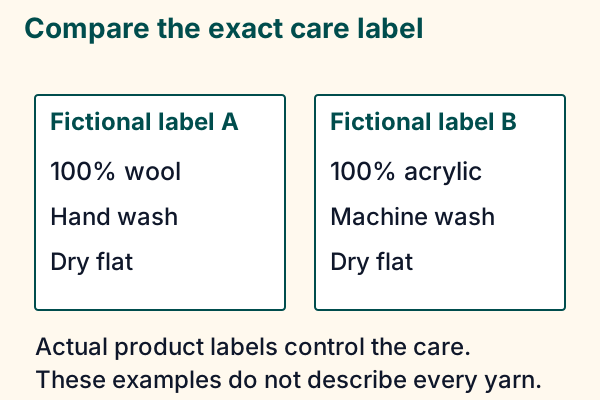
Some wool yarns permit machine washing; others can felt under unsuitable heat and agitation. Many acrylics permit machine washing but prohibit pressing or steam. Follow the exact product label. If giving the item away, include that care information so the recipient can repeat the conditions.
Compare purchases with the same units
In a hypothetical label comparison, yarn A costs $8 for 200 m and yarn B costs $6 for 120 m. A costs $4 per 100 m; B costs $5 per 100 m. This arithmetic does not compare quality or establish current market prices. Once the intended stitch and finished gauge match, estimate the total length for each candidate and round to whole skeins. A heavier ball can still contain less length, and a blend belongs to its own care specification rather than either pure-fiber column.
Avoid promises the label cannot support
Acrylic is not universally hypoallergenic, colorfast or suitable for every baby item. Wool is not automatically itchy or automatically appropriate for sensitive skin. Choose for known wearer preferences and the project’s requirements. A fiber comparison does not certify a material for specialized protective or safety uses.
- For frequent washing, compare labels and a laundering sample.
- For textured garments, inspect the finished drape and recovery.
- For substitution, compare actual length and gauge rather than grams.
- Store finished items clean and according to their care requirements.
Read the blocking guide before applying heat.
A useful estimate starts small.
Estimate project yarn from a measured and weighed swatch, with the assumptions kept in view.
Explore the planning toolSources & editorial notes
- Woolmark — Caring for wool — https://www.woolmark.com/care/care-for-wool
- Lion Brand — Choosing the Right Yarn — https://www.lionbrand.com/community/blog/choosing-the-right-yarn/
- Lion Brand — Yardage per skein — https://support.lionbrand.com/support/solutions/articles/17000035214-yardage-per-skein
- Sources checked 13 November 2026. Original arithmetic and schematic teaching diagrams; hypothetical samples are identified. No independent hands-on craft testing, product performance testing or named expert review is claimed.