How to Double Crochet
Learn US double crochet with a ten-stitch practice sample, clear loop counts and an explicit turning-chain convention.
In this guide
Double Crochet (dc) is taught here in US terminology; the equivalent name is UK treble crochet. Work a small flat sample first so you can see the hook motion and keep the same width when turning. A pattern may use a different turning-chain convention; its count controls its edges.
Set up a visible practice sample
You need smooth light-colored yarn, a hook near the label’s suggested size, two locking markers, scissors and a blunt yarn needle. Avoid furry or very dark yarn for the first attempt. Know the slip knot, chain and yarn-over before starting. Hold the hook in whichever grip keeps your hand relaxed, with the working yarn controlled in the other hand. These directions assume a right-handed hook hold.
Count the foundation
Chain 12: the skipped chain-3 counts as stitch one, then nine actual dc give ten counted stitches. Place the slip knot on the hook without clamping it tight. Make relaxed chains of similar size; a foundation that is already too tight will pull the bottom edge inward even if later rows are loose.
Make the stitch
Yarn over, then insert
Wrap the working yarn once over the hook and enter the fourth chain from the hook. This lesson counts the three skipped chains as the first double crochet; they supply the starting height.
Bring up a loop
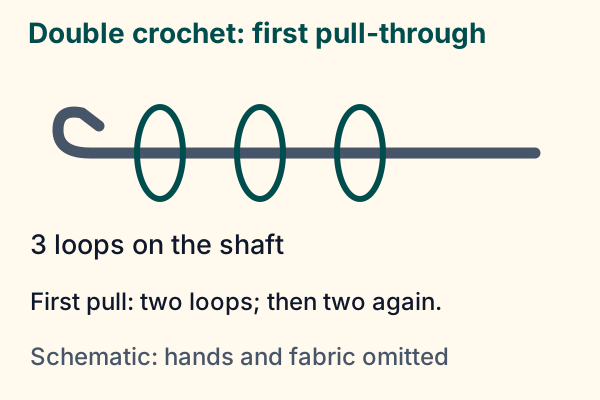
Yarn over and draw through the chain. You now have three loops. Hold the base of the stitch gently so that you can draw yarn through without dragging the whole chain upward.
Make two separate pulls
Yarn over and pull through the first two loops: two loops remain. Yarn over again and pull through the final two. One active loop remains. Do not pull through all three at once; that makes half double crochet.
Finish the first row
Continue into each remaining foundation chain. Pause at the end and count the stitch tops from above: each completed stitch has a V. Include the starting chain-3 as one stitch. Put a marker through the top of the first and last counted stitches. Marking now makes the next row’s edge easier to recognize.
Turn without changing the width
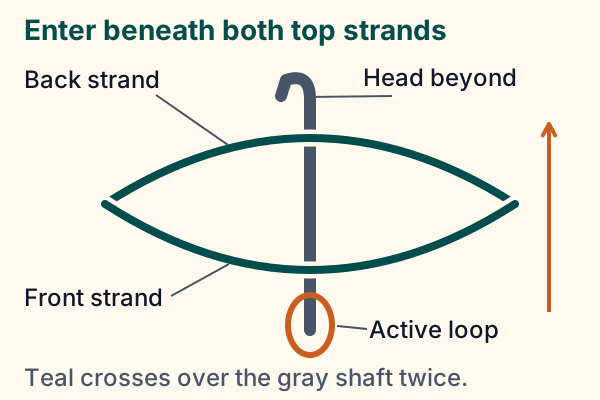
Chain 3 and turn. Count this new chain-3 as stitch one. Skip the actual stitch directly beneath it, then make dc into the next eight actual stitches and into the top of the previous turning chain. You again have a counted chain-3 plus nine dc: ten stitches. For subsequent rows, insert under both strands of the stitch-top V unless the pattern explicitly requests a front-loop or back-loop variation. Move the markers to the newly completed edge stitches.
Read the result and recover
Work four more rows, counting at each edge before turning. The practice should remain ten stitches wide. If the row narrows, check for an overlooked last stitch or missed top of the turning chain. If it grows, check for two stitches accidentally worked into one base or work inserted beneath the counted chain-3 as well. Undo to the last correctly counted stitch rather than hiding an edge error with a random increase or decrease.
Finish and assess the fabric
If the hook catches plies, back it out and remake that stitch through the whole strand. If loops will not pass over the hook head, loosen the new loops on the shaft and try a smaller pulling motion. On the last row, cut a tail long enough to thread and weave securely, draw it through the active loop, then weave it into the fabric. Wash the sample only as the label permits. Compare the dry width at top and bottom; even stitch counts can still look tapered while your tension is changing.
Use the crochet gauge calculator after measuring your finished sample. A taller stitch is not an exact height multiple of another stitch; measure each fabric instead of converting row counts by name.
Start with your swatch.
Estimate starting chains and fit them to a stitch-pattern repeat using your measured gauge.
Explore the planning toolSources & editorial notes
- Craft Yarn Council: Double Crochet — https://www.craftyarncouncil.com/mar06_dc.html
- Craft Yarn Council: Crochet Abbreviations and international differences — https://www.craftyarncouncil.com/standards/crochet-abbreviations
- Editorial review: primary sources accessed 13 November 2026; original practice examples and simplified schematics. No independent hands-on test or named expert review is claimed.